

DOCTRINE//The Cave Still Wins
Plato warned us about shadows on the wall. We just replaced the wall with screens.

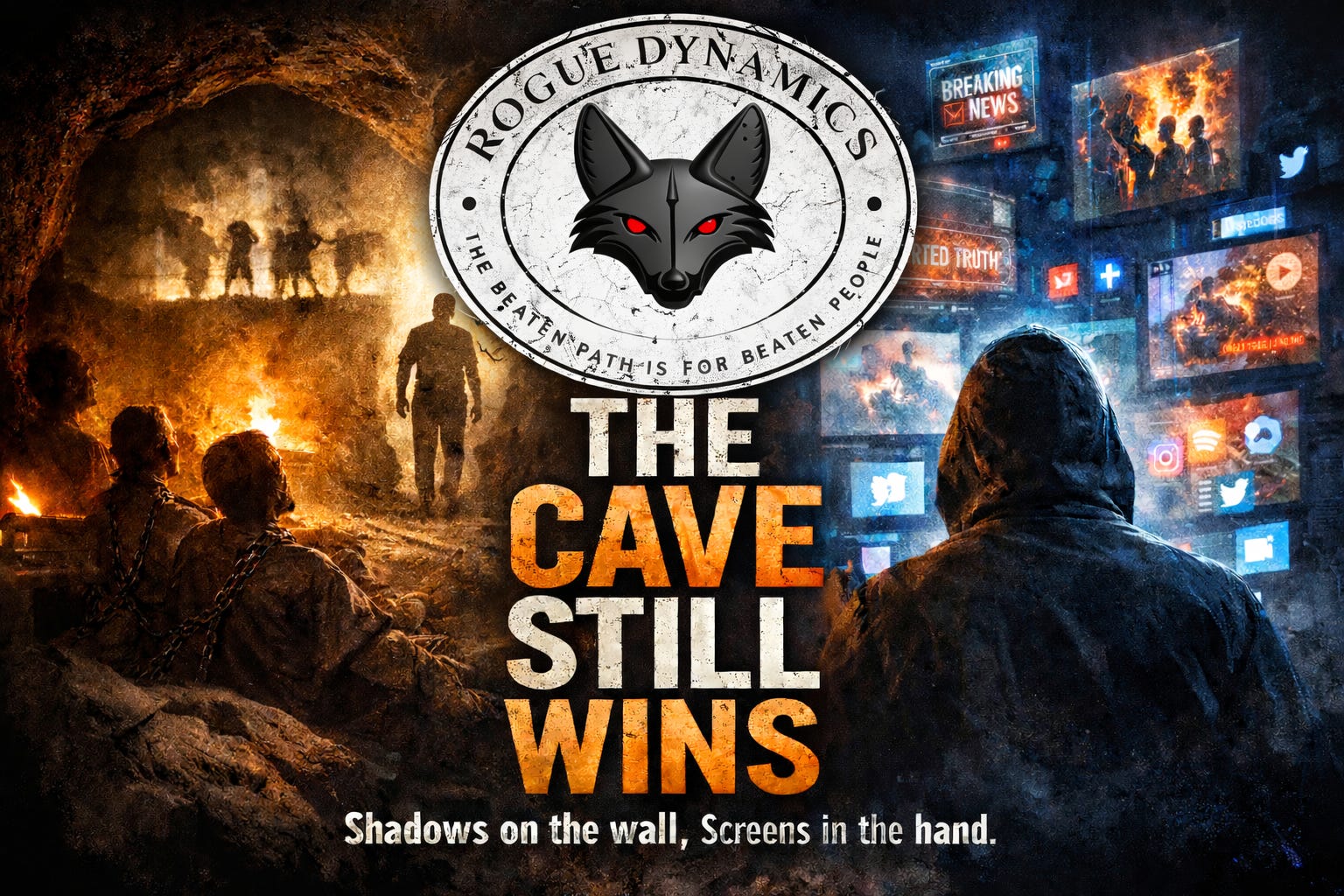
Plato’s Allegory of the Cave, found in The Republic, is often treated like a dusty philosophical exercise - something to be discussed in classrooms, quoted in passing, and then left behind in the ancient world where it supposedly belongs. That is a mistake. The cave did not disappear. It scaled like any other threat, as real as an insurgency but one that is trying to overthrow your mind and spirit.
In Plato’s account, prisoners are chained in place, watching shadows cast on a wall. Those shadows become their reality. They do not know what is true because they have never seen anything else. And when one prisoner breaks free, sees the world as it is, and returns to tell the others, they reject him. The truth is not welcomed. It is treated as a threat.
That is not just a story about ancient ignorance. It is a precise diagnosis of the modern life we find ourselves bombarded with every day.
Today’s cave is digital. It is built from social media feeds, outrage cycles, recycled talking points, manipulated images, poorly sourced headlines, and algorithms that reward emotional reaction over careful thought. The shadows are still there. They just move faster now. They come in high definition. They are branded, monetized, and pushed directly into your hand before you have even had your first cup of coffee.
Most people like to think they are informed because they are constantly exposed to information. But exposure is not understanding. Access is not discernment. There is no basis for assessing credibility; instead, it relies on familiarity and perceived trust. And volume is not the truth, most of all. In fact, one of the great deceptions of the modern age is the illusion that because we are surrounded by information, we must therefore be better equipped to understand the world. In reality, many people are drowning in fragments while starving for clarity.
That is where Plato becomes painfully relevant.
The prisoners in the cave are not stupid. They are conditioned. Their entire understanding of reality is shaped by what is placed in front of them. That same dynamic drives much of modern public life. People do not arrive at conclusions through disciplined inquiry. They absorb narratives. They inherit outrage. They repeat headlines they never bothered to verify and adopt positions built on clips, captions, and secondhand commentary. They confuse familiarity with truth. If they have seen it enough times, heard it from enough people, or watched it go viral, they assume it must be real.
That is how the cave works.
Social media has become the most efficient shadow machine ever created. It does not reward patience, depth, or intellectual humility. It rewards speed, certainty, anger, identity, and spectacle. A nuanced argument gets ignored. A half-true accusation catches fire. The system is not optimized for truth. It is optimized for engagement. That distinction matters because a platform built to maximize engagement will always favor provocation over clarification.
And poorly sourced news only makes that worse.
Bad information is no longer limited to fringe pamphlets and conspiracy corners. It now arrives with polished graphics, dramatic music, authoritative tones, and enough production quality to fool people into thinking credibility has been established. Sources are vague or absent. Claims are lifted from other weak claims. Context is stripped away. People read headlines instead of articles, clips instead of transcripts, summaries instead of source material, and then speak with the confidence of someone who has actually done the work. What they call awareness is often just curated ignorance.
This is not a minor cultural flaw. It is a strategic vulnerability.
A population that cannot distinguish between evidence and narrative is easy to manipulate. A citizenry trained to react instead of think becomes susceptible to political influence, social engineering, commercial exploitation, and mass psychological steering. Plato framed the problem in philosophical terms, but the implications are operational. Whoever controls the shadows controls perception. Whoever controls perception can shape behavior. And in the modern environment, that fight is happening constantly.
The difference between Plato’s cave and our present moment is that the ancient prisoners were chained by force. Most modern people are chained by appetite. They choose the feed. They choose the outrage. They choose the convenience of slogans over the burden of investigation. The cave today is portable, personalized, and voluntary. People carry it in their pockets and compulsively check it. They do not need to be imprisoned inside it. They have become attached to it.
That may be the most troubling part of all.
Plato understood that leaving the cave would be painful. The light would hurt. Reality would be disorienting. Truth would not feel comforting at first because truth often comes with the destruction of illusion. That remains true now. To step outside the modern cave requires discipline. It means slowing down when the crowd is rushing. It means asking basic but increasingly rare questions: Where did this come from? Who is the source? What is missing? What incentive is driving this narrative? What evidence actually exists beneath the performance? What is this trying to make me feel or do?
Most people do not want to live that way. They want the shortcut. They want their worldview confirmed, their tribe reinforced, and their suspicions validated. They want information that feels good in the moment, not information that demands self-correction. Truth requires effort. The cave does not.
And that is why the return from the cave remains so difficult.
In Plato’s allegory, the man who comes back with the truth is not celebrated as enlightened. He is dismissed, resisted, and treated as dangerous. That pattern has not changed. People rarely welcome those who interrupt the comfort of the illusion. Anyone who challenges the preferred narrative, exposes the weakness of the evidence, or points to the machinery behind the spectacle is often treated not as helpful but as hostile. The problem is not just that people are deceived. It is that many become emotionally invested in their deception.
They do not want the shadows questioned because the shadows have become part of their identity.
That is the real power of the cave. It does not merely hide reality. It trains people to resent those who seek it.
So, what does Plato offer us now?
He offers a warning. He reminds us that the central struggle is not merely political, technological, or cultural. It is epistemological. It is about whether people are still capable of distinguishing appearance from reality, performance from substance, and repetition from proof. That is not a side issue. It is the fight underneath all the others.
If we live in an age of mass distraction, manipulated narratives, and industrial-scale bad information, then the task is not simply to consume more content. It is to become harder to fool. It is to build habits of scrutiny in a world built to erode them. It is to resist the seduction of instant certainty. It is important to remember that being informed is not the same thing as being conditioned by a better class of shadows.
The cave is still here. It is louder now. Brighter now. Smarter now. But it is still a cave.
And most people are still staring at the wall.
If this sharpened your thinking, share it with someone who operates the same way.
If you want the kit that matches the mindset: https://roguedynamics.com
This is beautifully written. It resonates deeply and brings up feelings I didn’t realize I had.
Outstanding. Incredibly well-written and insightful piece. Bravo, and more of this, please!